
Table of Contents
Beyond Email: The New Frontier of AI in Engineering
For the past year, the noise around Artificial Intelligence in the AEC (Architecture, Engineering, and Construction) industry has been deafening. However, most of the conversation focuses on administrative productivity hacks: writing emails, summarizing meeting minutes, or drafting social media posts.
While useful, these applications barely scratch the surface of what Large Language Models (LLMs) and Multimodal AI can do for actual engineering workflows.
We are missing the bigger picture if we stop at text. AI has evolved into a powerful engineering visualization tool capable of bridging the gap between technical data and stakeholder understanding.
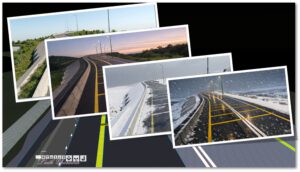
Recently, I decided to test the limits of this technology. My goal? To see if I could bypass the hours usually spent on heavy rendering software like Lumion, Twinmotion, or 3ds Max for quick conceptual visualizations. I wanted to turn a raw BIM screenshot into a client-ready render in under 60 seconds.
The results—from both Google’s Gemini and OpenAI’s ChatGPT—changed my perspective on our daily workflows forever.
Our growing library at Method Statement Central serves:
- Engineers who need precise and compliant templates
- Contractors who want to save preparation time
- Consultants looking for standardized documentation
- Students learning professional project procedures
We’re more than just a template provider — we’re your documentation partner, committed to helping you deliver projects with confidence and compliance.
The Experiment: Navisworks to Reality
The premise was simple. I didn’t want to export an FBX, set up textures, place trees manually, or bake lighting. I wanted to see if AI could “read” a technical screenshot and understand the engineering intent behind it.
Step 1: The Source Data
I prepared a standard Road BIM model for a highway infrastructure project. I took a raw, simple screenshot directly from Autodesk Navisworks.
- No fancy lighting.
- No material application.
- Just raw geometry and solid colors.
To the average client, this looks like a collection of grey shapes. To an engineer, it’s a design. I wanted AI to translate the latter for the former.

The Process: Prompting for Photorealism
I uploaded this screenshot to two different AI engines: Gemini (Nano-Banana) and ChatGPT (DALL-E 3).
My prompt was structured to be specific yet open to interpretation:
Round 1: Google Gemini Results
Gemini’s approach to the image was fascinating. It seemed to focus heavily on the atmospheric depth and the texture of the materials.
Prompt:“Render this engineering model with a realistic view. Visualize it in a highway environment with realistic asphalt textures, road markings, surrounding vegetation, and natural lighting. Keep the geometry consistent with the reference image.”
Prompt:“Render this engineering model with a realistic view. Visualize it in a highway environment with realistic asphalt textures, road markings, surrounding desert in a snowy weather, and natural lighting. Keep the geometry consistent with the reference image.”
- Observation: Gemini understood the topography incredibly well. It recognized that the grey mass was asphalt and applied a weathered texture that felt “lived-in.” The lighting interaction with the terrain created a sense of scale that is often hard to achieve manually without ray-tracing.
Round 2: ChatGPT (DALL-E 3) Results
Next, I fed the same Navisworks screenshot into ChatGPT.
Prompt:“Render this engineering model with a realistic view. Visualize it in a highway environment with realistic asphalt textures, road markings, surrounding vegetation, and natural lighting. Keep the geometry consistent with the reference image.”
Prompt:“Render this engineering model with a realistic view. Visualize it in a highway environment with realistic asphalt textures, road markings, surrounding desert in a snowy weather, and natural lighting. Keep the geometry consistent with the reference image.”
- Observation: ChatGPT took a slightly different artistic direction. The colors were often more vibrant, and the vegetation felt denser. It offers a great alternative “mood” for the project, perhaps better suited for marketing materials where a hyper-idealized look is preferred over a gritty, realistic one.
The Verdict: Why This Disrupts Civil Engineering
Comparing the original Navisworks screenshot with these AI-generated renders, the value proposition is undeniable. This isn’t just about making pretty pictures; it’s about efficiency, democratization, and speed.
1. Rapid Prototyping & Iteration
In a traditional workflow, changing the rendering environment from “Sunny Day” to “Rainy Night” requires tweaking HDRI maps, adjusting exposure settings, and re-rendering. With AI, it takes one sentence.
- Need to see how the road looks in a foggy morning? Just ask.
- Need to present a sunset view for a dramatic effect? Done in 10 seconds.
2. Stakeholder Communication
Clients, public stakeholders, and non-technical partners often struggle to visualize the final product from 2D CAD drawings or untextured BIM models. These AI renders bridge that cognitive gap instantly. You can now bring a “finished look” to a preliminary design meeting without spending the budget on a professional visualization studio.
3. Accessibility of Design
You no longer need to be a visualization expert or know how to use V-Ray to communicate a design intent. If you can describe it, you can render it. This empowers every engineer on the team to visualize their work, not just the dedicated BIM specialists.
Future Outlook: The Era of AI Collaboration
We are entering an era where our tools are becoming collaborators. The workflow I demonstrated above—Screen to Render—is just the beginning.
Soon, we will likely see plugins directly inside Civil 3D or Revit where AI renders the viewport in real-time as we design. Until then, using tools like Gemini and ChatGPT as an intermediate step is a massive competitive advantage.
Key Takeaway: Don’t let your BIM models stay trapped in the “grey world” of Navisworks. Use AI to bring them to life.
Have you experimented with AI for engineering rendering? Which result did you prefer—Gemini or ChatGPT? Let me know in the comments below!